Why we built an OAuth2 server in C++ — and benchmarked it against Keycloak, Ory, and Zitadel

Every identity server you can self-host today is a process: a JVM, a Go binary, a Node app. None of them is a library. That gap is where Fulla starts — and it's also why we ended up writing an OAuth2/OIDC server in C++17 and benchmarking it, on identical hardware, against Keycloak, Ory Hydra, and Zitadel.
This post covers four things: why the embeddable niche matters (§1), how we made a four-product comparison as fair as we could — including two findings that forced us to withdraw claims rather than publish them (§2), the numbers with their explicit limits (§3), and what the benchmarking process taught us beyond rankings (§4). Everything here is reproducible from the repository.
1. Why C++ for identity infrastructure?
If you operate a normal web product, you are spoiled for choice: run Keycloak, run Ory, run Zitadel, buy Auth0. Each is a standalone service you deploy next to your application. That model works — most of the time.
It stops working in a few specific places. A game server that wants to issue its own tokens without an extra network hop on the hot path. An edge box or an IoT gateway that has no room for a JVM. A C++ trading system whose team would rather not add a second runtime to their audit surface. In those worlds, "just deploy an identity provider" means shipping real infrastructure for what could have been a dependency.
Fulla is that dependency. It is an OAuth2/OIDC engine written in C++17 that you consume the way you consume any other library:
find_package(fulla-oauth2 REQUIRED)
target_link_libraries(your-app PRIVATE fulla::oauth2)
The engine assembles from SDK packages the same way in your build tree as in ours. To quantify what "library-sized" means, we built a minimal host — 184 lines of C++ that links only the SDK packages and drives the authorization-code flow's core steps (scope decision → code issuance → token exchange) end to end. Peak working set: 2.5 MB. Binary: 12 MB. There is no database requirement — repositories are ports, and an in-memory implementation ships in the SDK for tests and embedded use.
None of this is a claim that C++ is the language for identity. It's a claim that one niche — identity embedded in a C++ host — had no first-class option. Performance, for the record, is the output of that choice, not the reason for it; we'll get to the measured numbers, and their limits, in §3.
2. How to benchmark four identity servers fairly
Comparisons are cheap to publish and expensive to trust. Most "X vs Y" posts measure one product carefully and the others as an afterthought. We tried to do the opposite: one methodology, applied identically, with every raw result committed to the repository.
The environment. A single WSL2 host (8 vCPU, 16 GB RAM) running all
four products serially, with docker compose down -v between products so
no state leaks across sessions. One PostgreSQL 17 instance for whichever
product was under test. Load from wrk 4.1.0, the same staircase everywhere:
2 → 4 → 8 → 16 → 32 → 64 → 128 connections, 5 s warmup (discarded), 10 s
measured per level.
The competitors. Keycloak 26.7.1, Ory Hydra v26.2.0, Zitadel v4.17.1 — each on its officially recommended configuration. Two decisions worth calling out:
- Zitadel version. We deliberately picked v4 over the older v2 line that most tutorials use: v2 is two majors behind, and the eventstore and projection rework in v4 is exactly what their own published benchmarks measure. Benchmarking a stale major would misrepresent the product.
- Connection pools. Where a product has a pooling mechanism, we aligned
it to 25 connections (appendix A of the report documents each product's
knob). Fulla runs its documented benchmark profile — pools 64/64, cache
on, batch mode,
reuse_port, opt-in LTO build, 30-second sessions — which is the configuration our performance docs recommend, not a hidden tuning fork.
The scenarios. Five, each isolating a different path: discovery
(static metadata — the framework ceiling), client_credentials (RS256
signing + a client lookup + token persistence), introspect (RS256
verification + a live-status lookup), refresh_token (rotation + reuse
detection + new issuance), and userinfo (bearer validation + a user
record read). The authorization-code + PKCE flow (our S4) is not in the
suite: it's a multi-step browser flow whose orchestration differs too much
across products to stage comparably. We say so in the report rather than
pretending otherwise.
Two findings we withdrew
The methodology earned our trust the hard way — twice.
The Keycloak user-pool expiry. In the first full session, Keycloak's
userinfo numbers collapsed to 100% errors at higher concurrency. It would
have been easy to publish that. Instead we dug in: our refresh-token
staircase had re-signed ~90k refresh tokens, which aged the shared user
pool past the realm's 1-hour accessTokenLifespan — every userinfo call
was correctly rejecting expired tokens. The bug was in our staging, not in
Keycloak. We fixed it (the pool is re-minted before userinfo, baked into
keycloak/run-all.sh) and re-ran the scenario in a targeted session. The
numbers you see below are from that corrected run.
The GC-jitter claim we decided not to make. The obvious marketing narrative for a C++ IAM is "no GC, no tail-latency spikes." When we ran a five-minute latency series for all four products, every one of them — JVM, Go, and C++ alike — showed the same ~1.8 s periodic spikes, at the same time, on the same machine. Four-way agreement is not evidence about runtimes; it's evidence about the host. So we withdrew the claim entirely: this post makes no tail-latency-smoothness argument, in either direction, until we can re-measure on bare metal.
Both stories are in the report, not just in this post. That's the point: if a benchmark can embarrass its author, it's probably honest.
Reproducibility
The report is generated, not written:
gen-comparison.py
aggregates the committed JSONs (no hand-entered numbers, newest
same-session group wins) into COMPARISON.md. One command re-runs a
product's suite; one command regenerates the report. If your hardware
differs from ours, run it — we'd genuinely rather see your numbers than
win an argument.
3. Results — with their limits
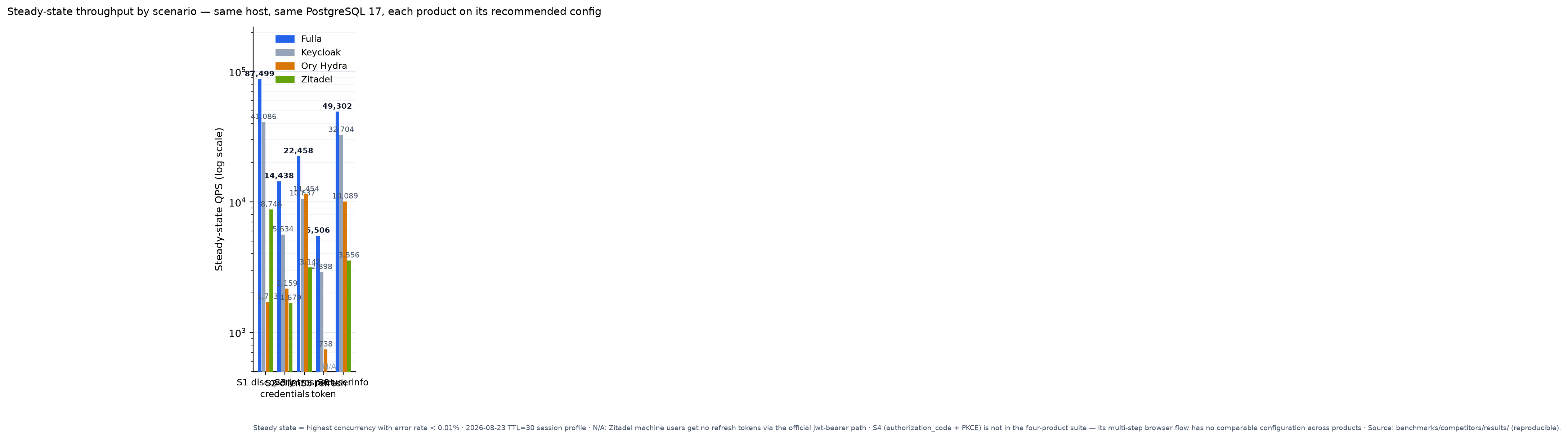
Steady state below means the highest concurrency level whose error rate stayed under 0.01%:
| Scenario | Fulla | Keycloak | Ory Hydra | Zitadel | Fulla vs best |
|---|---|---|---|---|---|
| S1 discovery | 87,499 | 41,086 | 1,713 | 8,746 | 2.1× |
| S2 client_credentials | 14,438 | 5,634 | 2,159 | 1,679† | 2.6× |
| S3 introspect | 22,458 | 10,637 | 11,454‡ | 3,142† | 2.0× |
| S5 refresh_token | 5,506 | 2,898 | 738 | N/A | 1.9× |
| S6 userinfo | 49,302 | 32,704 | 10,089 | 3,556 | 1.5× |
† Zitadel's official machine-to-machine path is the RFC 7523 jwt-bearer grant with private-key JWT — we benchmarked their documented path rather than forcing client_secret semantics onto it. Machine users on that path receive no refresh tokens, hence the S5 N/A.
‡ Hydra's introspection was measured through its admin API, its documented route for the operation.
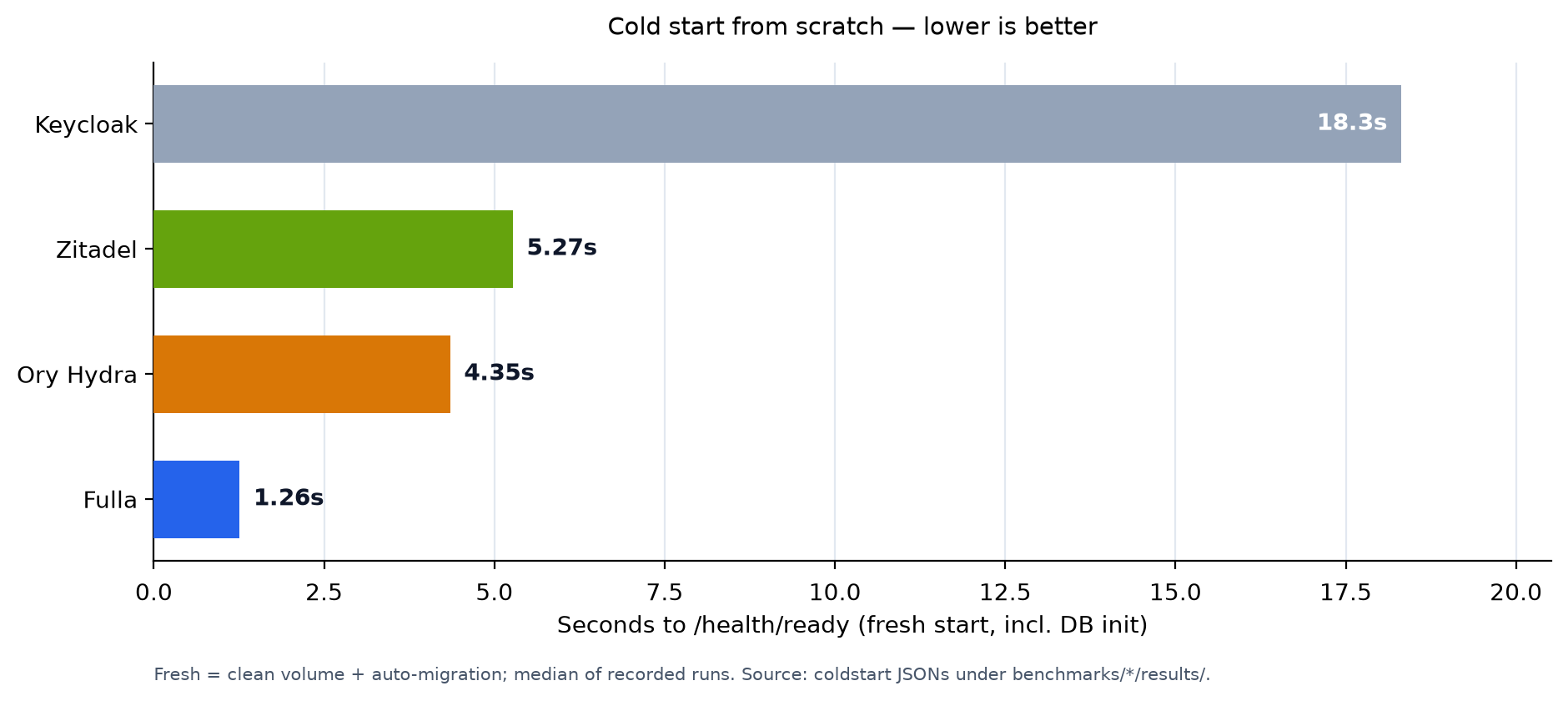
Cold start — clean volume, auto-migration included, median of recorded runs — is the most lopsided picture: 1.26 s for Fulla against 4.4 s (Hydra), 5.3 s (Zitadel), and 18.3 s (Keycloak). For autoscaling pools and edge deployments, that gap compounds.
Now the limits, because they are part of the result:
- 87k is not "the QPS." It's the stateless discovery endpoint. Token issuance — the number that pays the database round-trip and an RS256 signature — is 14.4k. Any summary of this post that says "100k+ QPS" has already misquoted it.
- These are lower bounds. All runs stayed under 44% driver CPU on a virtualized host. On bare metal every product moves; the ratios, we believe, are the durable part.
- Memory has two honest numbers, not one. Embedded as a library, Fulla peaks at 2.5 MB (§1). As a full container stack — Postgres, Redis, connection pools, the works — it is the heaviest of the four at ~2.35 GB, with Ory the lightest at 269 MB. If your constraint is host-process footprint, the first number is yours; if it's rack density, Ory deserves your attention. We're not going to blur the two scopes into one flattering figure.
4. What the benchmark taught us beyond rankings
The comparison produced four lessons that outlive the leaderboard. All of them are encoded as comments in the benchmark scripts, which is where lessons belong.
"Compose up auto-seeds" is a myth. Postgres's initdb does not
recurse into mounted subdirectories, and the app's migration runner does
schema only — never seed data. Several of our early "benchmark results"
were actually measuring empty-database fast paths. The fix is unglamorous
and now documented: apply seed SQL explicitly, with a retry loop that
tolerates the migration runner's startup race.
Refresh-token pools are ammunition, not fuel. Fulla rotates refresh
tokens and revokes the family on reuse detection — which means every
refresh token is single-use. A naive load script re-uses tokens and
measures the reuse detector, not the refresh path. The refresh scenario
now re-mints a fresh token pool before every concurrency level
(--reseed). If you benchmark any server with rotation, check what your
load tool actually does here before trusting the output.
Rate limiters punish the benchmark, not just the bug. Our token
endpoint's failure limiter is keyed on (ip, client_id) — one shared
bucket. A single buggy early run burned the failure budget for every
virtual user, and everything after it ate 429s for a minute. The symptom
looks like a server problem; the cause is one mis-scripted client sharing
a bucket with a hundred well-behaved ones.
Session retention is TTL-bounded by design — measure before you call it a leak. During long staircases, Fulla's memory climbed with concurrency, which looked like a leak. It wasn't: sessions live as long as the session timeout, so memory is bounded by TTL × arrival rate. Dropping the benchmark profile's session timeout from 120 s to 30 s (a retention-bounded profile) improved steady-state throughput and cut full-stack RSS from 5.35 GB to 2.35 GB. The investigation, the formula, and the mitigation guidance are all in the performance docs — because "it's not a leak, here's the math" is only convincing when you show the math.
5. What Fulla is, and what's next
Fulla is an open-source identity core for C++17: OAuth2 and OIDC covering authorization-code with mandatory PKCE, client credentials, refresh rotation with reuse detection, device flow, introspection, revocation, and RP-initiated logout — plus an admin console, a user portal, organizations with member management and self-service application registration (v1.4.0), Helm and Docker deployment, and a Postgres-backed storage layer with an optional Redis cache. AGPL-3.0, Open Core. Three ways to consume it:
- C++ SDK:
find_package— the embedded path this post is about, with an integration guide and a runtime contract. - Python client:
pip install fulla-oauth2 - Go client:
go get github.com/voidvec/fulla/clients/go
Documentation lives at fulla.dev — including
llms.txt and
llms-full.txt, so if you're an AI
agent (or building one) reading this, the docs are machine-readable too.
The benchmark methodology, raw JSONs, and report are in
the repository.
What's next, in order: organization-aware protocol semantics (organization claims and admin consent for B2B use), becoming a fully MCP-compliant authorization server (RFC 8707 audience binding, RFC 9207, CIMD) plus OIDC upstream federation — and the federation features we honestly still lack, SAML and SCIM, stay customer-driven, smallest viable subset first. A bare-metal re-measurement is also on the list so the tail-latency question we withdrew in §2 can get a real answer.
If any of this is useful to you, the repo is voidvec/fulla — star it if you're so inclined. Better yet, run the comparison on your hardware and tell us what you see.